

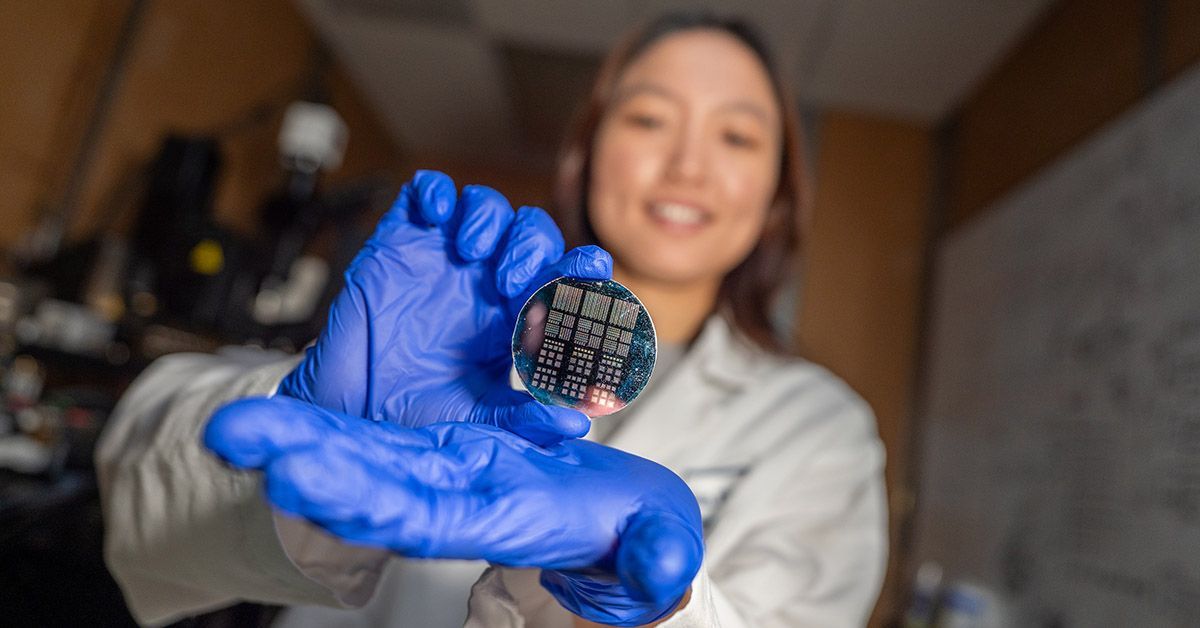
The device processes information using a strategy called spatiotemporal computing, which analyzes signals both over time and through spatial interactions across the network. Incoming signals are first converted into electrical spikes and sent into the network. Interacting nodes transform those signals into complex internal patterns that capture both timing information and network dynamics. A second layer of programmable junctions then reads those patterns and performs classification tasks.
The researchers demonstrated the approach using two simulated applications. In one, the system successfully recognized spoken digits with high accuracy. In another, it detected early signs of epileptic seizures from electroencephalogram (EEG) signals. In both cases, the system outperformed methods that relied only on time-based processing.
In the seizure-detection test, the system identified warning signals even when given only a few seconds of brain data. Because activity in one node influences others, early signals from a few channels can spread across the network and help the system detect seizures sooner.
Further, the system operates extremely quickly — on the scale of hundreds of nanoseconds — and uses very little energy, about 0.2 nanojoules per operation.
That efficiency could make the technology useful for edge AI applications, where small devices must process data locally with limited power instead of sending it to large data centers, Kuzum noted. Potential uses include wearable medical devices, smart sensors, audio processing systems and autonomous machines.
The technology is still at an early stage. Hardware demonstrations so far have focused on small-scale tasks, while larger tasks such as speech recognition and seizure detection were tested through simulations based on experimental measurements.
Future work will focus on scaling up the system; integrating it with conventional semiconductor electronics; and exploring additional applications.
Full study: Protonic nickelate device networks for spatiotemporal neuromorphic computing
This work was made possible by collaborations and funding provided by Q-MEEN-C, an EFRC funded by the U.S. DOE, Office of Science, Basic Energy Sciences, under Award No. DE-SC0019273. Senior collaborators include study co-authors Ertugrul Cubukcu, professor in the Aiiso Yufeng Li Family Department of Chemical and Nano Engineering at UC San Diego; Eva Andrei, professor in the Department of Physics and Astronomy at Rutgers University; and Shriram Ramanathan, professor in the Department of Electrical and Computer Engineering at Rutgers University. Q-MEEN-C is directed by Ivan Schuller, distinguished professor of physics at UC San Diego.
Learn more about research and education at UC San Diego in:
link