


Industrial WLAN Market Summary
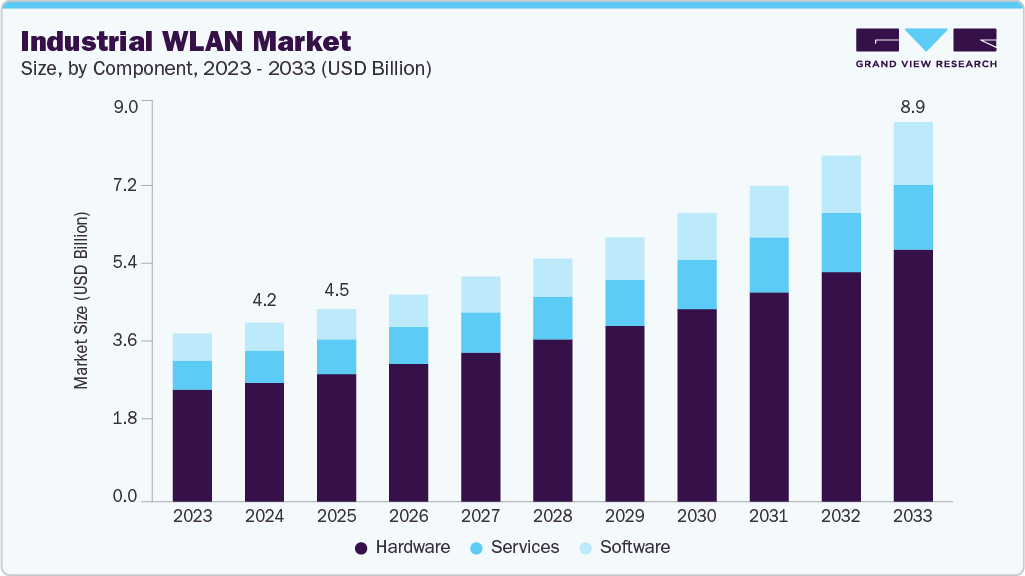
The global industrial WLAN market size was estimated at USD 4.23 billion in 2024, and is projected to reach USD 8.94 billion by 2033, growing at a CAGR of 8.8% from 2025 to 2033. The adoption of high-speed wireless connectivity and advanced WLAN standards such as Wi-Fi 6 has emerged as a significant trend in the global industrial WLAN market, driven by the rise of Industry 4.0, the proliferation of IIoT devices, and the growing need for real-time data exchange in smart manufacturing environments.
Key Market Trends & Insights
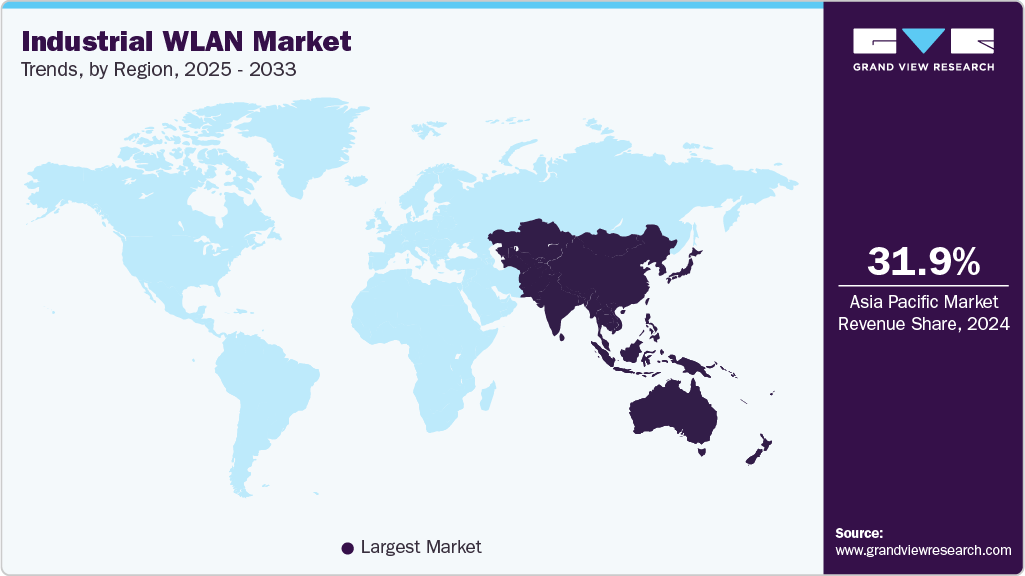
- The Asia Pacific industrial WLAN market accounted for a 31.9% share of the overall market in 2024.
- The industrial WLAN industry in China held a dominant position in 2024.
- By component, the hardware segment accounted for the largest share of 66.5% in 2024.
- By technology standard, the 802.11ax (Wi-Fi 6/6E) segment held the largest market share in 2024.
- By deployment type, the on-premise segment dominated the market in 2024.
Market Size & Forecast
- 2024 Market Size: USD 4.23 Billion
- 2033 Projected Market Size: USD 8.94 Billion
- CAGR (2025-2033): 8.8%
- Asia Pacific: Largest market in 2024
The development and adoption of standardized wireless protocols serve as a fundamental driver propelling the industrial WLAN market growth. Institutions like the National Institute of Standards and Technology (NIST) have been instrumental in establishing best-practice frameworks through partnerships with industry leaders, including the 2017 IEEE-NIST joint workshop focused on wireless technology selection, spectrum management, and testing procedures.
This collaboration has resulted in standardized industrial wireless protocols such as ISA100.11a and IEEE 802.11 variants optimized for industrial applications. For example, the IEEE 802.11ax amendment incorporates orthogonal frequency-division multiple access (OFDMA) to enhance deterministic communication, which is essential for real-time robotic control and motion-critical tasks. By reducing interoperability issues and offering validated network architectures, this standardization is accelerating the deployment of WLAN systems in legacy industrial infrastructure, thereby boosting market growth.
The Industrial WLAN market is further propelled by the surge in IIoT applications that require ultra-reliable, low-latency communications (URLLC). The 5G Alliance for Connected Industries and Automation (5G-ACIA) has set stringent operational technology (OT) benchmarks for industrial wireless, such as achieving latencies below 10 milliseconds for robotic assembly and real-time monitoring.
To meet these demands, industrial WLAN protocols like Wireless Network for Industrial Automation, Factory Automation (WIA-FA) have integrated time-division multiple access (TDMA) techniques, providing deterministic performance once limited to wired systems. For instance, WIA-FA supports data rates of up to 250 Mbps with latency under 2 milliseconds, enabling seamless wireless connectivity for collaborative robots in automotive production. This trend, highlighted by the IEEE Industrial Electronics Society, is expanding wireless use cases from basic process automation to complex, dynamic manufacturing operations, thereby driving market adoption.
Regulatory policies expanding the availability of unlicensed spectrum are significantly boosting industrial WLAN capabilities and market growth. The Federal Communications Commission’s (FCC) 2020 ruling to open the 6 GHz band (5.925-7.125 GHz) for unlicensed use has been a game changer, offering 1.2 GHz of additional bandwidth. This spectrum expansion enables IEEE 802.11ax (Wi-Fi 6E) networks to utilize wide 160 MHz channels, delivering multi-gigabit speeds essential for bandwidth-heavy industrial applications such as augmented reality (AR) maintenance and 4K video surveillance.
The FCC’s rules support both outdoor standard-power access points (via automated frequency coordination) and indoor low-power devices, providing versatile deployment options across diverse industrial sites. Early adopters in sectors like oil and gas report data transmission speed improvements of up to 40% for pipeline monitoring through 6 GHz WLAN, underscoring the direct impact of spectrum policies on market expansion.
As industrial WLAN deployments grow, regulatory bodies are imposing rigorous cybersecurity requirements to protect critical infrastructure, further propelling market demand for secure wireless solutions. The U.S. Nuclear Regulatory Commission (NRC) requires comprehensive security impact analyses (SIAs) for wireless devices in nuclear plants, addressing threats such as radio frequency interference (RFI) and denial-of-service (DoS) attacks.
Regulatory Guide 5.71 mandates that wireless systems connected to safety-critical equipment undergo thorough penetration testing and adopt layered security strategies, including air-gapped networks and cryptographic authentication. For instance, a 2023 wireless vibration sensor deployment in a pressurized water reactor mandated AES-256 encryption and physical system isolation to comply with NRC rules. These stringent cybersecurity mandates drive demand for industrial WLAN products with built-in protections like secure boot and over-the-air firmware updates, boosting the market’s growth trajectory.
Component Insights
The hardware segment accounted for the largest revenue share of 66.5% in 2024. The hardware segment continues to act as the backbone of industrial WLAN infrastructure, but its role is evolving from being purely functional to enabling real-time data orchestration. Industrial access points are becoming increasingly rugged, compact, and edge-AI compatible, especially to support robotic fleets and mobile assets in smart manufacturing zones. The rise of Wi-Fi 6/6E is prompting a refresh cycle in factories where low-latency and high device density are mission-critical.
The software segment is expected to grow at the fastest CAGR during the forecast period. The software layer is transitioning from basic WLAN management tools to intelligent orchestration platforms. Cloud-native WLAN software solutions are integrating with IoT ecosystems, offering dynamic bandwidth allocation, predictive maintenance analytics, and AI-driven network diagnostics. The software is no longer just an accessory, and it’s becoming the nerve center for automation-led connectivity, especially in hybrid deployments.
Technology Standard Insights
The 802.11ax (Wi-Fi 6/6E) segment held the largest revenue share in 2024. Wi-Fi 6/6E is reshaping industrial network expectations, particularly with its ability to handle dense device environments and deterministic latency. It’s the workhorse of the Industry 4.0 era, enabling connected PLCs, AGVs, and AR-enabled maintenance operations in harsh environments. Adoption is surging in brownfield plants that are retrofitting legacy systems to meet modern communication standards.
The 802.11be (Wi-Fi 7) segment is expected to grow at a significant CAGR during the forecast period. Wi-Fi 7 is still emerging, but is already influencing procurement plans among future-ready industrial operators. Its ultra-high throughput and lower jitter make it ideal for real-time control, autonomous robotics, and 3D inspection systems. While current deployments are limited, early trials in semiconductor fabs and digital twin environments highlight Wi-Fi 7’s role as the wireless backbone of next-gen industrial intelligence.
Deployment Type Insights
The on premise segment dominated the market in 2024. Despite the cloud wave, on-premise deployment retains a stronghold in industries with strict data sovereignty and deterministic control requirements. High-security environments such as aerospace, pharma, and automotive continue to favor local WLAN control to mitigate latency and cybersecurity risks. The trend here is toward edge-compute-integrated WLAN hubs that act both as network access points and decision-making nodes.
The cloud-based segment is projected to grow at the fastest CAGR over the forecast period. The industrial cloud-based WLAN segment is growing at a breakneck pace, driven by the need for scalability and multi-site visibility. Cloud WLAN allows manufacturers to spin up networks faster across geographies while centrally managing access, performance, and updates. The integration of cloud WLAN with ERP, MES, and digital twin platforms is a major catalyst, especially in mid-size and contract manufacturing units embracing plug-and-play automation.
Application Insights
The machine-to-machine communication segment dominated the market in 2024 and is projected to grow at a significant CAGR over the forecast period. M2M communication is the foundational use case for industrial WLANs, but it is rapidly evolving with edge-AI and adaptive routing. Modern WLAN systems now enable peer-to-peer data exchanges between robots, sensors, and controllers without overloading central systems. This decentralization is key in smart assembly lines where microsecond decision cycles and reliability are non-negotiable.
The inventory & asset tracking segment is projected to grow at the fastest CAGR over the forecast period. Wi-Fi-powered asset tracking is enabling real-time visibility of parts, tools, and personnel. With hyperlocal positioning technologies layered onto WLAN, manufacturers can now minimize downtime, shrink idle inventories, and move toward zero-touch supply chains. Integration with RFID-over-Wi-Fi is making asset tracking not just reactive, but predictive.
End User Industry Insights
The general manufacturing segment dominated the market in 2024 and is projected to grow at a significant CAGR over the forecast period. The general manufacturing sector is democratizing WLAN use, expanding from large OEMs to mid-size fabricators and contract producers. The driving force here is modular automation, and WLAN enables fast reconfiguration of production cells without physical rewiring. Smart lighting, HVAC automation, and remote machine analytics are no longer pilot projects but mainstream initiatives riding on secure, scalable WLAN networks.
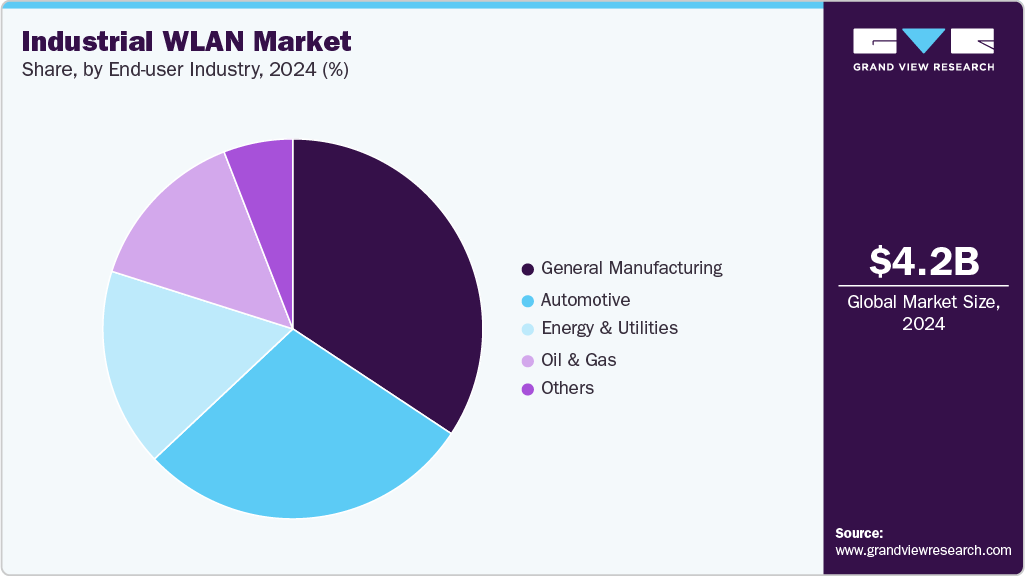
The energy & utilities segment is projected to grow at the fastest CAGR over the forecast period. In a sector known for conservatism, WLAN is quietly transforming grid substations, renewable asset monitoring, and utility workforce mobility. The shift from centralized SCADA to distributed, wireless edge telemetry is powering faster outage response and proactive maintenance. The rise of smart meters, digital substations, and grid-edge AI is turning WLAN from a communication tool into a strategic utility enabler.
Regional Insights
The North America industrial WLAN market accounted for 30.7% share of the overall market in 2024. North America is rapidly advancing its industrial WLAN capabilities, driven by coordinated regulatory efforts and substantial investments in wireless infrastructure. The region benefits from harmonized spectrum policies that enable seamless cross-border industrial wireless deployments, critical for manufacturing and industrial sectors with interconnected supply chains.
U.S. Industrial WLAN Market Trends
The U.S. industrial WLAN market held a dominant position in 2024. The U.S. is making significant strides in industrial wireless technology thanks to efforts led by the National Institute of Standards and Technology (NIST). Their projects, like the Industrial Wireless Systems Testbeds and Wireless Systems for Industrial Environments, focus on boosting the performance, reliability, and integration of Wi-Fi 6 (802.11ax) in factory settings.
On the regulatory side, the Federal Communications Commission’s (FCC) landmark decision in March 2024 to open the entire 6 GHz band for unlicensed Very Low Power (VLP) devices is a real game-changer. This move provides industrial WLAN systems with much-needed clean spectrum to support fast, low-latency communications crucial for automation and smart manufacturing. Together, these research initiatives and spectrum reforms are driving the U.S. toward advanced and resilient industrial wireless networks.
Europe Industrial WLAN Market Trends
The Europe industrial WLAN market was identified as a lucrative region in 2024. In Europe, organizations like ETSI and CEPT have been pushing for harmonized wireless local area network (RLAN) standards and coordinated use of mid-band spectrum, especially the 6 GHz band, to enable high-performance industrial WLAN infrastructure. These efforts are vital for scalable, multinational deployments. A 2023 ETSI report reaffirmed that the harmonized standards ensure efficient spectrum use, limit interference, and comply with the EU’s Radio Equipment Directive, all of which foster consistent industrial WLAN adoption across member states.
Germany industrial WLAN market is growing significantly due to various funding initiatives and support. Germany’s Mittelstand 4.0 program, supported by the Federal Ministry for Economic Affairs and Energy (BMWi), is actively funding digital innovation hubs and IIoT laboratories to help small and medium-sized enterprises adopt industrial wireless systems. This includes WLAN-based automation and monitoring solutions. As a result, Germany is rapidly integrating WLAN technologies throughout its traditional manufacturing sectors, becoming a leading example of wireless-driven industrial modernization.
The UK industrial WLAN market aligns closely with European and North American wireless standards through its participation in ETSI, CEPT, and APEC. This harmonization supports reliable industrial WLAN deployments across manufacturing, energy, and logistics sectors. Additionally, the UK’s adoption of trans-Atlantic spectrum-sharing frameworks helps advance robust WLAN infrastructure, driving innovation and digital transformation in industries reliant on seamless wireless connectivity.
Asia Pacific Industrial WLAN Market Trends
The Asia-Pacific industrial WLAN market accounted for 31.87% share of the overall market in 2024. Asia-Pacific industrial WLAN market is experiencing rapid growth in the global market. Across the Asia-Pacific region, the APEC forum supports industrial wireless growth through initiatives like its Telecommunications and Information Working Group (TLSWG) and Digital Economy projects. The APEC IoT Development platform focuses on policies and technical integration for industrial connectivity across member economies such as Japan and China. These frameworks are driving APAC’s strategic push toward smart factories, connected utilities, and advanced digital infrastructure.
China industrial WLAN market is driven by the country’s initiatives, such as “Made in China 2025” strategy explicitly aims to transform its manufacturing sector through smart automation, IIoT, robotics, and high-performance communications, including industrial WLAN. The government has dedicated hundreds of billions of RMB to pilot smart factory and communication projects, positioning WLAN as a critical backbone technology for China’s next-generation industrial landscape.
India industrial WLAN market is growing significantly. India’s Digital India mission, championed by the Ministry of Electronics and Information Technology (MEITY), along with the National Digital Communications Policy (NDCP) of 2018, sets the stage for expanding digital and wireless infrastructure. Recent Production Linked Incentive (PLI) schemes worth billions are boosting electronics manufacturing, enabling advanced industrial WLAN deployments along key manufacturing corridors. With ongoing telecom spectrum modernization and digital infrastructure investments, India is steadily building a solid foundation for industrial wireless connectivity.
Key Industrial WLAN Company Insights
Some major players in the industrial WLAN market include Cisco Systems, Inc., Commscope Inc., D-Link Limited, Extreme Networks, among others, due to a combination of advanced wireless technologies, strong global distribution networks, and the ability to deliver highly scalable, secure, and reliable connectivity solutions for industrial environments. Their success is also driven by continued investments in R&D, enabling support for next-generation standards like Wi-Fi 6 and Wi-Fi 7, ruggedized hardware for harsh operating conditions, and integration with broader industrial automation platforms. Moreover, these companies form strategic alliances with cloud providers and industrial automation firms, further embedding their solutions in smart factories, energy grids, logistics, and manufacturing ecosystems across diverse geographies.
-
Huawei Technologies Co., Ltd. has positioned itself as a dominant force in the global Industrial WLAN market through its robust portfolio of high-performance wireless solutions tailored for industrial automation, smart manufacturing, and IIoT applications. The company is a front-runner in deploying Wi-Fi 6 and Wi-Fi 7-enabled infrastructure across sectors such as energy, transportation, and heavy manufacturing, particularly in Asia-Pacific and emerging markets. Huawei’s emphasis on end-to-end network integration, seamless cloud connectivity, and proprietary chips for wireless optimization has made its industrial WLAN offerings both scalable and efficient. Its strong foothold in national digital transformation initiatives and collaborations with manufacturing giants further amplify its impact in this space.
-
Juniper Networks has gained significant traction in the industrial WLAN space through its AI-driven networking approach, especially following the acquisition of Mist Systems. By embedding machine learning and automation into wireless infrastructure, Juniper delivers highly reliable and intelligent WLAN solutions suited for complex industrial environments. These systems are designed to ensure real-time network visibility, proactive anomaly detection, and minimal downtime, key requirements in mission-critical industrial settings. With growing adoption in manufacturing, logistics, and utilities, Juniper’s strategy of integrating AI, cloud management, and secure wireless access is propelling its influence in the Industrial WLAN ecosystem.
Key Industrial WLAN Companies:
The following are the leading companies in the industrial WLAN market. These companies collectively hold the largest market share and dictate industry trends.
- Cisco Systems, Inc.
- Commscope Inc.
- D-Link Limited
- Extreme Networks
- Fortinet, Inc.
- Hewlett Packard Enterprise Development LP
- Huawei Technologies Co., Ltd.
- Juniper Networks, Inc.
- Ruckus Wireless
- Siemens
Recent Developments
-
On June 6, 2025, at the Huawei Network Summit 2025 (Asia Pacific) in Hong Kong, China, Huawei, in collaboration with the World WLAN Application Alliance (WAA) and industry pioneers, released the “Smart Campus Wi-Fi CSI Sensing Development and Use Cases White Paper.” This white paper explores Wi-Fi Channel State Information (CSI) sensing trends, extending Wi-Fi from connectivity to sensing, and delves into extensive use cases on smart campuses, including industrial safety (e.g., intrusion detection) and smart healthcare (e.g., vital sign detection).
-
On February 12, 2025, Juniper Networks announced new additions to its wired access portfolio, including the Juniper Networks EX4000 Series Switches. These switches are designed to maximize uptime, enable Zero Trust security, and deliver the performance and scale needed for Wi-Fi 7, which is crucial for high-density industrial environments.
Industrial WLAN Market Report Scope
|
Report Attribute
|
Details
|
|
Market size value in 2025
|
USD 4.54 billion
|
|
Revenue forecast in 2033
|
USD 8.94 billion
|
|
Growth rate
|
CAGR of 8.8% from 2025 to 2033
|
|
Base year for estimation
|
2024
|
|
Historical data
|
2021 – 2023
|
|
Forecast period
|
2025 – 2033
|
|
Quantitative units
|
Revenue in USD billion and CAGR from 2025 to 2033
|
|
Report coverage
|
Revenue forecast, company ranking, competitive landscape, growth factors, and trends
|
|
Segments covered
|
Component, technology standard, deployment type, application, end user industry, region
|
|
Regional scope
|
North America; Europe; Asia Pacific; Latin America; MEA
|
|
Country scope
|
U.S.; Canada; Mexico; Germany; UK; France; China; Japan; India; South Korea; Australia; Brazil; KSA; UAE; and South Africa
|
|
Key companies profiled
|
Cisco Systems, Inc.; Commscope Inc.; D-Link Limited; Extreme Networks; Fortinet, Inc.; Hewlett Packard Enterprise Development LP; Huawei Technologies Co., Ltd.; Juniper Networks, Inc.; Ruckus Wireless; Siemens
|
|
Customization scope
|
Free report customization (equivalent up to 8 analysts working days) with purchase. Addition or alteration to country, regional & segment scope.
|
|
Pricing and purchase options
|
Avail customized purchase options to meet your exact research needs. Explore purchase options
|
Global Industrial WLAN Market Report Segmentation
This report forecasts revenue growth at the global, regional, and country levels and provides an analysis of the latest industry trends in each of the sub-segments from 2021 to 2033. For this study, Grand View Research has segmented the global industrial WLAN market report based on component, technology standard, deployment type, application, end user industry, and region:
-
Component Outlook (Revenue, USD Billion, 2021 – 2033)
-
Hardware
-
Software
-
Services
-
-
Technology Standard Outlook (Revenue, USD Billion, 2021 – 2033)
-
802.11a/b/g
-
802.11n
-
802.11ac (Wi-Fi 5)
-
802.11ax (Wi-Fi 6/6E)
-
802.11be (Wi-Fi 7)
-
-
Deployment Type Outlook (Revenue, USD Billion, 2021 – 2033)
-
On-premise
-
Cloud-based
-
Hybrid
-
-
Application Outlook (Revenue, USD Billion, 2021 – 2033)
-
Machine-to-Machine Communication
-
Inventory & Asset Tracking
-
Worker Mobility & Communication
-
Automation & Control Systems
-
Others
-
-
End User Industry Outlook (Revenue, USD Billion, 2021 – 2033)
-
Automotive
-
General Manufacturing
-
Oil & Gas
-
Energy & Utilities
-
Others
-
-
Regional Outlook (Revenue, USD Billion, 2021 – 2033)
Frequently Asked Questions About This Report
b. The global industrial WLAN market size was estimated at USD 4.23 billion in 2024 and is expected to reach USD 4.54 billion in 2025.
b. The global industrial WLAN market size is expected to grow at a significant CAGR of 8.8% to reach USD 8.94 billion in 2033.
b. Asia-Pacific (APAC) held the largest market share of 31.9% in 2024. Across the Asia-Pacific region, the APEC forum supports industrial wireless growth through initiatives like its Telecommunications and Information Working Group (TLSWG) and Digital Economy projects.
b. Some of the players in the industrial WLAN market are Cisco Systems, Inc., Commscope Inc., D-Link Limited, Extreme Networks, Fortinet, Inc., Hewlett-Packard Enterprise Development LP, Huawei Technologies Co., Ltd., Juniper Networks, Inc., Ruckus Wireless, and Siemens.
b. The key driving trend in the industrial WLAN market is the integration of Industrial Internet of Things (IIoT) and edge computing into manufacturing and automation environments, which is significantly boosting the demand for secure, high-speed wireless connectivity. Industries are increasingly adopting Industrial WLAN solutions to enable real-time data transmission between machines, sensors, and control systems, enhancing operational efficiency, remote monitoring, and predictive maintenance.
link