

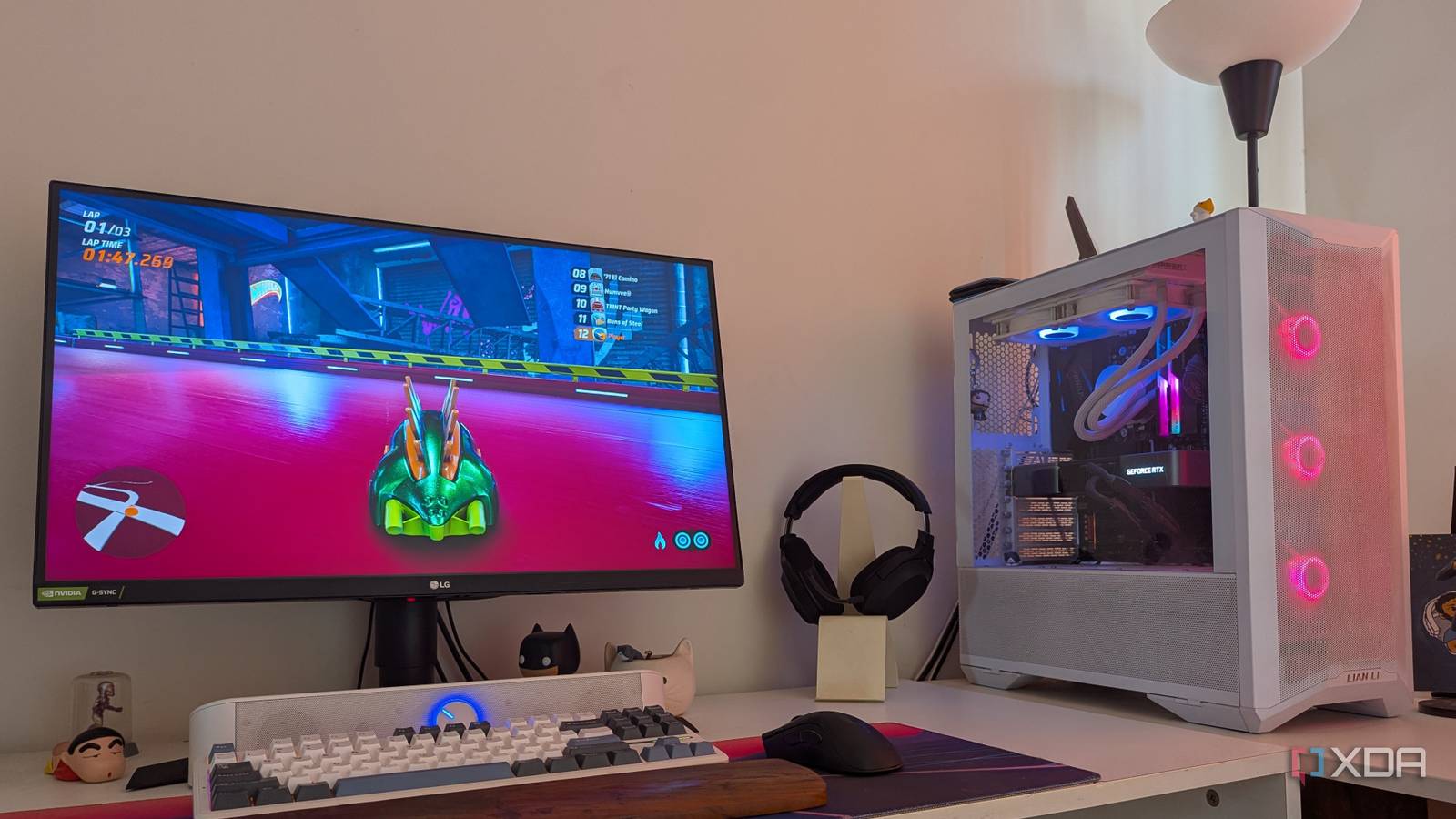
We’re living in a time when PC hardware has progressed to the point that things have started to look boring. We have SSDs breaching 14,000MB/s speeds, gaming monitors casually sporting 500Hz refresh rates, and high-end graphics cards rewriting what top-tier gaming means. That said, I’m not fully convinced by many of these technologies and features, especially those that have the word “next-gen” tied to them. Whether it’s bleeding-edge Wi-Fi standards or even Ryzen X3D CPUs, I’m still not buying into modern PC hardware.
Monitors with ridiculously high refresh rates
When is it high enough?
When we first started getting high-refresh-rate displays with 120Hz–144Hz models, millions of gamers opened their eyes to a whole new frontier of gaming. We were used to 60Hz displays for so long that using a 144Hz monitor felt like a game-changing upgrade. Moving from 144Hz–165Hz displays to 240Hz models didn’t really feel like that, and apart from those playing competitive titles, most people were fine with the previous frontier. Then came the really high-refresh-rate displays.
360Hz, 480Hz, and even 500Hz models kept launching one after the other, boasting several “world’s first” records. These sky-high numbers might convey “high fidelity” to the consumer, but what are we really upgrading here? The gaming experience of most people depends on the image quality, responsiveness, and size of the display. And you can ace all of those with a last-gen, high-refresh-rate OLED monitor. So, what’s the point of pushing refresh rates higher and higher?
It’s not like GPU technology is progressing at the same pace — we’ve been seeing AI-generated frames compensating for poor generational gains lately. When gamers are prioritizing resolution, HDR, and color accuracy more than ever, these crazy refresh rates don’t do anything to convince the average buyer. And if you prefer 4K to 1440p, your maximum refresh rate will inevitably be limited due to the additional pixels. You’ll gain almost nothing by opting for a 360Hz display instead of a 240Hz or 180Hz one.
Wi-Fi 7
No one really needs it
Most of the world is still using Wi-Fi 5 routers and Wi-Fi 6/6E motherboards, but Wi-Fi 7 is routinely pushed as the solution to all your Wi-Fi woes. Firstly, a huge chunk of the PC population uses a wired connection for its obvious advantages. Secondly, Wi-Fi 6E has already solved for speed, latency, and range for most people. Lastly, Wi-Fi 7 is a catch-all term that doesn’t mean the same thing in different parts of the world. Wi-Fi routers might be equipped for the high bandwidth of Wi-Fi 7, but your motherboard probably isn’t.
Most ISPs don’t even offer the kind of speeds that would make the jump to Wi-Fi 7 feasible. We don’t even have enough Wi-Fi 7 devices on the market, and Wi-Fi 8 is already underway, promising even better reliability. While Wi-Fi 7 improves on the 6GHz band introduced by Wi-Fi 6E, improving channel width, latency, and efficiency, realistic adoption is still a few years away. Even if the next iPhone brings Wi-Fi 7 support, your router and ISP plan will remain the same.
PCIe 5.0 SSDs
Still waiting for the performance revolution
I’m still trying to justify upgrading to a Gen5 SSD when I go for a full platform upgrade next year. I’ll be moving from AM4 to AM5, which will mean a new Ryzen CPU, DDR5 motherboard, and DDR5 memory, but I’ll stick with my Gen4 NVMe SSD. It’s been a minute since PCIe 5.0 SSDs arrived, and we’re still trying to figure out their usefulness for the average PC user. Sure, the cutting-edge sequential speeds might benefit some users, but everyone else has nothing to gain from these expensive and high-performance drives.
Besides the transfer speeds not translating into real-world benefits, Gen5 SSDs have many other problems. They run hot, can be too bulky for some PCs, and aren’t drop-in upgrades for many people. DirectStorage was supposed to push the adoption of these next-gen drives in gaming PCs, but we all know what happened there. Upcoming PCIe 6.0 SSDs seem utterly pointless in this case, and will most likely be even harder to handle for most PCs.
AMD’s 3D V-Cache
Doesn’t deliver for most people
AMD’s Ryzen X3D CPUs have taken gaming CPUs to a whole new level, but they only excel when certain conditions are met. For a Ryzen 7 9800X3D to make a tangible difference to a system already running, say, a Ryzen 5 7600X, you need to pair it with an RTX 5080 or RTX 5090. Otherwise, the difference in performance between these two CPUs will be negligible with graphics cards like the RX 9070 and RX 9060 XT.
And if you happen to have a high-end setup built for 4K gaming, you can actually save a lot of money by skipping a Ryzen X3D CPU, and pairing a 6-core chip with your high-end GPU. Games at 4K become almost completely GPU-bound, and you won’t get any extra FPS with your $450 X3D CPU. Those who have the money to buy the best components on the market will obviously go for the Ryzen 7 9800X3D or even the Ryzen 9 9950X3D. Others who want a versatile chip that excels in both gaming and productivity will pick something else.
Ray tracing
Still needs crutches like frame generation
Ray tracing isn’t a new thing for GPUs; it was introduced with Nvidia’s RTX 20 series GPUs back in 2018. However, even after 7 years, it faces the same questions around performance, visual impact, and price of entry. With modern GPUs rapidly climbing in prices, gamers need to spend at least $600 (realistically more) on a graphics card capable of decent ray tracing. If that’s not enough, there are only a handful of games where ray tracing delivers an objectively better experience.
And to top it off, the performance penalty of turning it on hasn’t really come down — tools like upscaling and frame generation have convinced us otherwise. I might even excuse upscaling, since the final image is almost indistinguishable from a native one. Frame generation, however, is a half-baked solution to a problem that it doesn’t even solve. It’s a tool that needs an already high-enough framerate to deliver a decent final output, and even that is stuck at the responsiveness level of the base framerate.
Ray tracing has become a mainstay in modern titles and GPU technology, but I prefer immersive displays, better storytelling, and unique art styles over slightly better lighting and shadows.
Here’s a radical thought: existing tech should become cheaper
Instead of new technologies and gimmicks like frame generation, we should be getting OLED monitors, high-end graphics cards, and Gen5 SSDs at more affordable prices. Most people would be happier if they could run the latest games at native 60 FPS without relying on upscaling and frame generation. OLED monitors represent the pinnacle in gaming displays, but they’re still out of the reach of most gamers.
link