


Above: The matte black Century Encode is Schlage’s most popular electronic lock, and the Latitude lever in matte black is popular as well.
Technology
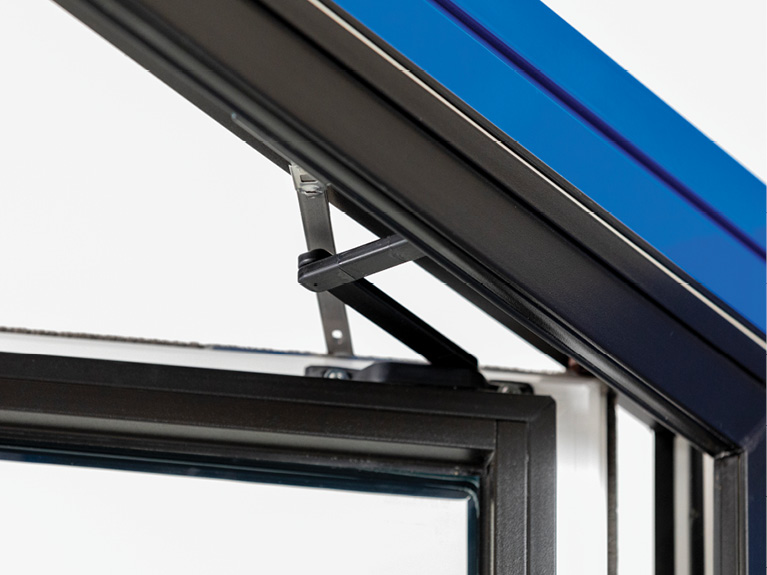
Technology makes new gains in the window and door world every day. From automating the opening and closing of windows and doors to smart glass, no element of a unit is off-limits.
The AmesburyTruth product team at Quanex is introducing a solution that connects electricity to glass in operating units. “This breakthrough enables smart glass technologies, such as switchable privacy glass, electrochromic tinting, solar energy harvesting and motorized blinds between the glass—expanding beyond traditional fixed or stationary window applications,” says Nissen.
Roto, meanwhile, is partnered with AutoSlide, which is an electronic device that can mount above a sliding or hinge patio door and allows the user to open and close the door on demand via an app or keypad.
Finding the right market for automated solutions can present challenges, though. “Our market is almost 100% the original equipment manufacturer and we’re finding many don’t want to deal with electronics from an installation and after-market perspective,” says Gray. “They know how to service their windows and doors from an operational and functional perspective, but servicing something with electronics puts them into a whole other category.”
Technology continues to work to integrate with the Matter protocol, an open-source smart home standard that allows devices from different manufacturers to communicate with each other. “You’re starting to see everything shift toward working through the Matter protocol so that you can choose your hardware,” says Whitt.
One such Matter-enabled device is Schlage’s recently introduced Sense Pro. It doesn’t have a key; rather, it’s electronic and uses an app on a smartphone or smart watch.
It will sense when the user is approaching the door and automatically unlock the door. Because it uses the Matter protocol, explains Whitt, it will connect through any smart home app the user wants to use. Ultimately, Matter will allow a homeowner to control any smart home device—from doors to appliances to lighting and more—through a single app of their choosing.
Market demands
Housing affordability remains a top priority for the National Association of Home Builders. As the market continues to grapple with affordability concerns, manufacturers and suppliers are taking note. “With the growing challenge of affordable housing, the industry is under pressure to deliver cost-effective solutions. We are actively collaborating with our engineering team to develop innovations that meet these demands, ensuring high-performance products remain accessible to a broader market,” says Nissen.
Labor shortages and succession planning also factor in business decisions. “Roto, as well as many other companies in this industry, are faced with a substantial succession plan in their personnel going forward,” says Roto’s Gray. “It’s going to be fascinating to see what happens. I think this is one reason why I believe the GlassBuild America show floor today is more than 50% dedicated to manufacturing equipment, because the fabricators are spending money on automation because they have labor concerns. They know in three to five years they’re going to have succession to deal with. I think they’re making investments now, so they’ll be prepared to have a reduced workforce that is knowledgeable going forward.”
Jeske’s Whitt agrees labor is a top concern. “You’re starting to see a lot of the experienced hardware people retiring. One of our biggest areas of growth is training our project managers to help our customers. It’s not always about price. Sometimes, it’s about who can help get the job done and make it work.”
Jeske uses technology to automate as many processes as possible, explains Whitt. This enables the company to store information in one place, thereby increasing efficiency and accuracy.
“Instead of having 10 highly skilled people on staff, we can have two or three and they can help others,” he says. “The biggest way you learn is through mistakes, so you need to have a good process to take care of issue and problems as quickly as possible.”
Jeske’s Basch also notes the company compiled training materials to start people at the basics, no matter what department they come into. “It’s hard to find anyone with knowledge of hardware, so we have to create our own,” says Whitt. “If we can find those employees that can learn, you start out with the basics—metals, finishes, types of products, functions—and build from there. Then they learn through experience.”
Nissen sums the hardware market up neatly: “The window and door hardware market is entering an exciting phase of growth and innovation, driven by strong customer partnerships and evolving industry needs. Smart technology is gaining momentum, but the real challenge lies in developing affordable solutions that are accessible to a broader market, not just high-end buyers. Additionally, with the ongoing affordable housing shortage, our customers are seeking collaborative partners to help identify opportunities and deliver cost-effective, high-performance solutions that bridge the gap.”
link