


We sit in an era of great uncertainty. Geopolitical turbulence
dominates the headlines as new trade wars pressure businesses and
consumers alike. In the last few weeks, the U.S. implemented a 25%
tariff on steel and aluminum imports, significantly impacting
Canada and Europe. Meanwhile, the U.S. also incrementally raised
tariffs across the board on China, which responded with its own set
of tariffs on U.S. agricultural imports. What happens in the weeks
and months to come remains unclear but will no doubt disrupt global
economies.
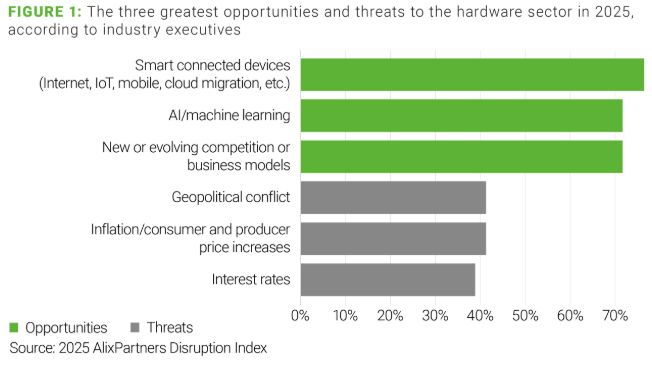
According to the2025 AlixPartners Disruption Index,
geopolitical conflict is the top threat to technology hardware
companies worldwide. This instability leads to inflation, price
concerns, and interest rate increases. But alongside these threats,
hardware executives are optimistic about the impact cutting-edge
technologies will have on the industry in 2025. Namely, they see
smart connected devices, AI, and machine learning—as well as
the new business models these technologies bring about—as
major growth opportunities.
The tech hardware companies that can weather the storm of
uncertainty while capitalizing on these opportunities will become
the industry leaders in this new age of artificial
intelligence.
Key strategies for hardware companies to minimize impact and
maximize innovation
As geopolitical concerns swirl, hardware companies should focus
on what they can control—effectively responding to tariffs.Our assessmentsuggests that currently
announced tariffs will, on average, have a 7% impact on the cost of
goods sold (COGS) across the broader technology hardware ecosystem.
The threat is severe, and companies that act decisively and
deliberately will have the upper hand in a competitive
landscape.
A successful tariff strategy starts with the establishment of
a“tariff war room.”Bringing together the
relevant cross-functional business stakeholders with tariff experts
makes it easier to review tariff situations and quickly execute
effective mitigation tactics. These include:
- Incumbent vendor negotiations:Leveraging
supplier footprints, manufacturing capabilities, and supply chain
options to minimize tariff impacts. - Customer pass-through strategies:Deciding
which costs to absorb and which to pass on to customers. - Rapid-duty engineering:Tactical supply chain
restructuring to reduce short-term tariff effects.
To make the most of technological advancement opportunities,
hardware companies need to act quickly, form the right
partnerships, and boost internal capabilities:
- Prioritize speed:Our clients employ a variety
of approaches in this rapidly changing hardware landscape. These
include running smaller, more agile experiments to test and
validate processes before building out further, as well as
co-developing solutions with partners to promote a wider sourcing
of ideas and faster supply chain movement to new architecture. - Build partnerships:Hardware players need to
forge partnerships with companies at the forefront of innovation
(e.g., agentic AI, machine learning, IoT, etc.) to embed these
technologies into products. Securing these partnerships will
improve speed-to-market and capture of new market share. Companies
must also reevaluate go-to-market partnerships, as enhanced
products may open new opportunities. - Fine-tune innovation capabilities (e.g.,
R&D):Given a market in flux, innovation and
engineering teams need to focus on “design-for-X”
capabilities (e.g., value, innovation, speed-to-market), where the
“X” is optimized based on product needs, competitive
bids, or for regulatory or compliance reasons. To enable this,
companies must implement the right operating model with
self-sufficient regional hubs. These provide cross-functional teams
with clear decision-making swim lanes that can scale. Ensuring the
right operational leadership is in place and automating parts of
the process where feasible are also keys to driving innovation in
today’s technological climate.
How top companies are responding
Leading hardware companies have already taken action to
safeguard their margins from tariffs. Cisco, for example, has cut
its tariff exposure for goods and services made in China by 80%,according to CFO Richard Herren. To diversify
its supply chain, the company launched manufacturing and repair
operations in India in 2023. “We’ve game-planned out
several scenarios and steps we could take depending on what
actually goes into effect,” Herren said during Cisco’s Q2
earnings call.
Cisco has chosen to prioritize supply chain adjustments over
price increases in the current environment. Other top hardware
companies are following a similar approach. We believe this is a
winning strategy—acting decisively with proven tactics will
best mitigate tariff impacts and protect customers from price
increases.
The measures hardware players take to exploit opportunities are
just as important, if not more, as their reaction to threats.
Apple’s embrace of AI in its hardware has paid dividends.According to Canalys, 17% of the PCs shipped
worldwide in 2024 were AI-capable, the majority of which (54%) were
Apple machines. The company continues to evolve its channel
strategy,recently announcing the Apple Partner Network
programin an effort to build share in the enterprise
segment.
As geopolitical tensions rise, hardware companies have no choice
but to adapt. Agility is the key to success—those that can
swiftly navigate tariff impacts while embedding technologies like
AI and machine learning into their products will thrive. With the
right strategies, partnerships, and innovation-led approaches, tech
hardware companies will not only survive but also lead the charge
into an era of growth and opportunity.
The content of this article is intended to provide a general
guide to the subject matter. Specialist advice should be sought
about your specific circumstances.
link